Nexarcor Takes Aim at the Growing Challenge of Customer Management
South African technology platform focuses on helping businesses bring leads, sales opportunities and customer relationships into one organised pipeline


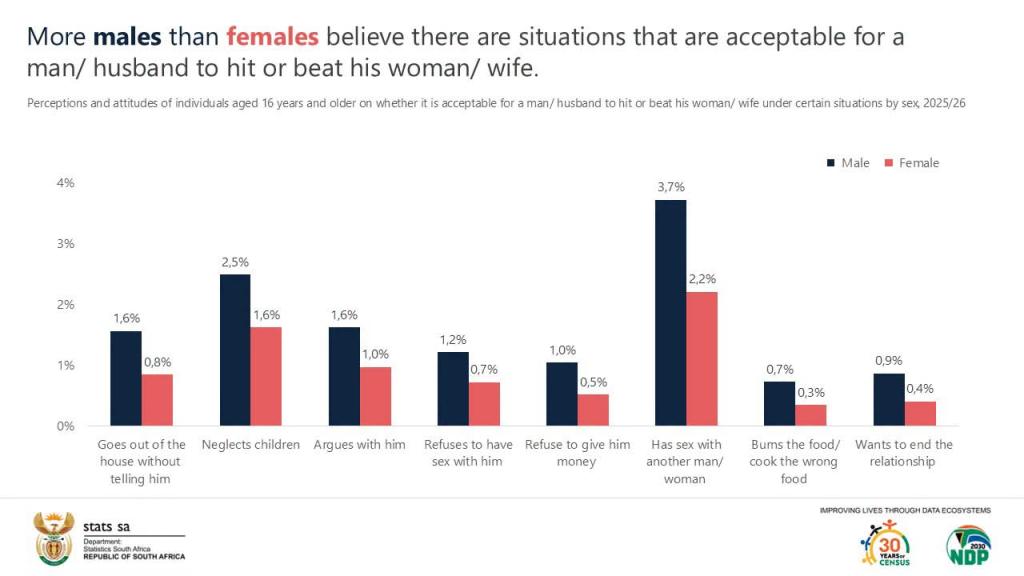
A new set of figures from Statistics South Africa (Stats SA) has highlighted a disturbing gender gap in attitudes towards violence against women, with men consistently more likely than women to say there are circumstances in which it is acceptable for a husband or man to hit or beat his wife or partner.
The figures, covering individuals aged 16 and older for 2025/26, do not mean that most South Africans believe domestic violence is acceptable. In fact, the percentages shown are relatively small. However, the data reveals that men were more likely than women to hold this view across every situation measured.
According to the Stats SA figures, the situation with the highest reported acceptance was a woman having sex with another man.
Among men, 3.7% indicated that they believed this could be a situation in which it was acceptable for a man or husband to hit or beat his wife.
Among women, the figure was 2.2%.
The figures were considerably lower for the other situations measured, but the same pattern remained.
One of the situations measured was a woman refusing to give her husband or partner money.
The figures show:
said this could be a situation in which hitting or beating a woman was acceptable.
In other words, men were twice as likely as women to express this view.
It is important to stress that the statistics describe people's perceptions and attitudes. They do not mean that Stats SA considers hitting a woman acceptable, nor do they mean that the majority of men support violence against women.
The gender difference appeared across all eight situations included in the graphic:
| Situation | Men | Women |
|---|---|---|
| Goes out of the house without telling him | 1.6% | 0.8% |
| Neglects children | 2.5% | 1.6% |
| Argues with him | 1.6% | 1.0% |
| Refuses to have sex with him | 1.2% | 0.7% |
| Refuses to give him money | 1.0% | 0.5% |
| Has sex with another man/woman | 3.7% | 2.2% |
| Burns the food/cooks the wrong food | 0.7% | 0.3% |
| Wants to end the relationship | 0.9% | 0.4% |
The data shows that men recorded higher percentages in every category.
Although percentages such as 3.7% and 2.2% may appear small, attitudes towards domestic violence are an important social issue.
The most concerning aspect of the figures may not simply be the size of the percentages, but the fact that some respondents continue to see certain disagreements or relationship problems as circumstances that could justify physical violence.
Refusing sex, refusing money, arguing, wanting to leave a relationship or cooking the wrong food are disagreements or personal choices. None provides a legitimate justification for physical violence.
The figures therefore provide an opportunity for South Africans to examine how attitudes towards relationships, power and violence are formed and passed between generations.
The Stats SA graphic presents a particularly striking message: across all eight scenarios, men were more likely than women to say that hitting or beating a wife could be acceptable.
The highest figure among men was 3.7%, linked to sexual infidelity, while the highest among women was 2.2%.
That does not mean that 96.3% of men support women's rights or that 97.8% of women reject violence in all circumstances—the question is specifically about the situations measured. Nor should the figures be interpreted as saying that violence is generally accepted in South Africa.
Instead, the numbers point to a smaller but significant group whose attitudes towards intimate-partner violence remain troubling.
The message should be clear: disagreement, financial conflict, infidelity or the decision to end a relationship should never turn into violence.
Source: Statistics South Africa, 2025/26 perceptions and attitudes data shown in the supplied graphic.